Breaking News
Loading...

Random News

  • New Movies
  • Recent Games
  • Tech Review

Tab 1 Top Area

Tech News

Game Reviews

Recent Post

Showing posts with label Fishes. Show all posts
Tuesday, 22 October 2013
Blue Whale

Blue Whale

Blue Whales: are rorquals (family Balaenopteridae), a family that includes the humpback whale, the fin whale, Bryde's whale, the sei whale, and the minke whale. The family Balaenopteridae is believed to have diverged from the other families of the suborder Mysticeti as long ago as the middle Oligocene. It is not known when the members of those families diverged from each other. The blue whale is usually classified as one of eight species in the genus Balaenoptera; one authority places it in a separate monotypic genus, Sibbaldus, but this is not accepted elsewhere.

 Blue Whale
 Blue Whale
 Blue Whale
Blue Whale
Friday, 6 July 2012
Wrasse

Wrasse

Wrasse: The wrasses are a family, Labridae, of marine fish, many of which are brightly colored. The family is large and diverse, with over 600 species in 82 genera, which are divided into nine subgroups or tribes. They are typically small fish, most of them less than 20 centimetres (7.9 in) long, although the largest, the Humphead wrasse, can measure up to 2.5 metres (8.2 ft). They are efficient carnivores, feeding on a wide range of small invertebrates.

 Wrasse
 Wrasse
 Wrasse
 Wrasse
Wednesday, 16 May 2012
Jellyfish

Jellyfish

Jellyfish (also known as jellies or sea jellies or a stage of the life cycle of Medusozoa) are free-swimming members of the phylum Cnidaria. Medusa is another word for jellyfish, and refers to any free-swimming jellyfish life stages among animals in the phylum. Jellyfish have multiple morphologies that represent cnidarian classes including the Scyphozoa (over 200 species), Staurozoa (about 50 species), Cubozoa (about 20 species), and Hydrozoa (about 1000–1500 species that make jellyfish and many more that do not). Jellyfish are found in every ocean, from the surface to the deep sea.

Jellyfish
Jellyfish
Jellyfish
Jellyfish
Thursday, 10 May 2012
Starfish

Starfish

Starfish or sea stars are echinoderms belonging to the class Asteroidea. The names "starfish" and "sea star" essentially refer to members of the class Asteroidea. However, common usage frequently finds "starfish" and "sea star" also applied to ophiuroids which are correctly referred to as "brittle stars" or "basket stars". There are about 1,800 living species of starfish that occur in all the world's oceans, including the Atlantic, Pacific, Indian as well as in the Arctic and the Southern Ocean (i.e. Antarctic) regions. Starfish occur across a broad depth range from the intertidal to abyssal depths (>6000 m).

Starfish
Starfish
Starfish

 Starfish
Catfish

Catfish

Catfishes (order Siluriformes) are a diverse group of ray-finned fish. Named for their prominent barbels, which resemble a cat's whiskers, catfish range in size and behavior from the heaviest and longest, the Mekong giant catfish from Southeast Asia and the second longest, the wels catfish of Eurasia, to detritivores (species that eat dead material on the bottom), and even to a tiny parasitic species commonly called the candiru, Vandellia cirrhosa. There are armour-plated types and also naked types, neither having scales.

Catfish
Catfish
Catfish
Catfish
Friday, 4 May 2012
Octopus

Octopus

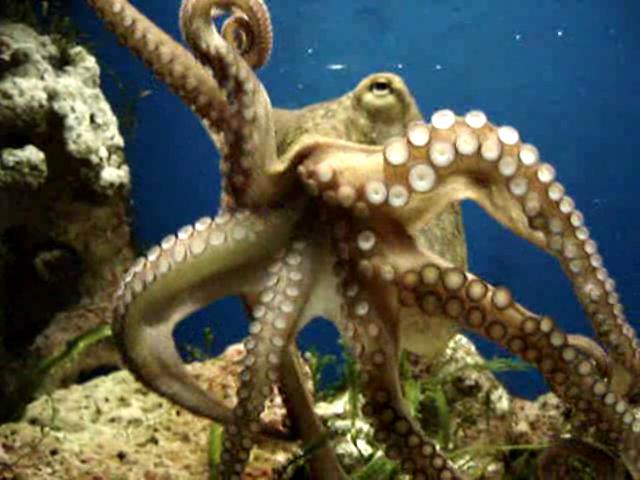
The Octopus is a cephalopod mollusc of the order Octopoda. Octopuses have two eyes and four pairs of arms, and like other cephalopods they are bilaterally symmetric. An octopus has a hard beak, with its mouth at the center point of the arms. Octopuses have no internal or external skeleton (although some species have a vestigial remnant of a shell inside their mantle), allowing them to squeeze through tight places. Octopuses are among the most intelligent and behaviorally flexible of all invertebrates.

Octopus
Octopus
Octopus
Octopus
Saturday, 21 April 2012
Angelfish

Angelfish

Pterophyllum is a small genus of freshwater fish from the family Cichlidae known to most aquarists as "Angelfish". All Pterophyllum species originate from the Amazon River, Orinoco River and Essequibo River basins in tropical South America. The three species of Pterophyllum are unusually shaped for cichlids being greatly laterally compressed, with round bodies and elongated triangular dorsal and anal fins. This body shape allows them to hide among roots and plants, often on a vertical surface. Naturally occurring angelfish are frequently striped longitudinally, colouration which provides additional camouflage. Angelfish are ambush predators and prey on small fish and macroinvertebrates.

Angelfish
Angelfish
Angelfish
Angelfish
Thursday, 19 April 2012
Flounder

Flounder

Flounder are a group of flatfish species. They are demersal fish found at the bottom of coastal lagoons and estuaries of the Northern Atlantic and Pacific Oceans. Flounder ambush their prey, feeding at soft muddy areas of the sea bottom, near bridge piles, docks and coral reefs, and have been also found at the bottom of the Mariana trench, the deepest known ocean canyon. Swiss scientist Jacques Piccard and US Navy Lt. Don Walsh reached a depth of 10,916 meters (35,814 ft) and were surprised to discover sole or flounder about 30 cm long. A flounder's diet consists mainly of fish spawn, crustaceans, polychaetes and small fish. Flounder typically grow to a length of 12.5–37.5 centimeters (4.9–14.8 in), and as large as 60 centimeters (24 in). Their width is about half their length.

Flounder
Flounder
Flounder
Flounder
Wednesday, 18 April 2012
Shark

Shark

Sharks (superorder Selachimorpha) are a type of fish with a full cartilaginous skeleton and a highly streamlined body. The earliest known sharks date from more than 420 million years ago. Since that time, sharks have diversified into 440 species. They range in size from the small dwarf lanternshark (Etmopterus perryi), a deep sea species of only 17 centimetres (6.7 in) in length, to the whale shark (Rhincodon typus), the largest fish in the world, which reaches approximately 12 metres (39 ft). Despite its size, the whale shark feeds only on plankton, squid, and small fish by filter feeding. Sharks are found in all seas and are common down to depths of 2,000 metres (6,600 ft).

Shark
Shark
Shark
Shark
Shark Whael

Shark Whael

The whale shark, Rhincodon typus, is a slow-moving filter feeding shark and the largest extant fish species. The largest confirmed individual had a length of 12.65 metres (41.50 ft) and a weight of more than 21.5 tonnes (47,000 lb), and there are unconfirmed reports of considerably larger whale sharks. This distinctively-marked fish is the only member of its genus Rhincodon and its family, Rhincodontidae (called Rhiniodon and Rhinodontidae before 1984), which belongs to the subclass Elasmobranchii in the class Chondrichthyes. The species originated about 60 million years ago. The whale shark is found in tropical and warm oceans and lives in the open sea with a lifespan of about 70 years.

Shark Whael
Shark Whael
Shark Whael
Shark Whael
Monday, 26 March 2012
Fish

Fish

Fish are a paraphyletic group of organisms that consist of all gill-bearing aquatic vertebrate (or craniate) animals that lack limbs with digits. Included in this definition are the living hagfish, lampreys, and cartilaginous and bony fish, as well as various extinct related groups. Most fish are ectothermic ("cold-blooded"), allowing their body temperatures to vary as ambient temperatures change, though some of the large active swimmers like white shark and tuna can hold a higher core temperature. They can be found in nearly all aquatic environments, from high mountain streams (e.g., char and gudgeon) to the abyssal. 

 Fish
 Fish
 Fish
 Fish
Copyright © 2012 Wild Life Planet All Right Reserved
Designed by CBTblogger